


In-Home Dog Training vs. Board and Train in Toronto: Which Is Right for Your Dog?


If you're looking for professional dog training in Toronto, you've probably come across two popular options: in-home dog training and board and train programs.
Both can be effective. Both have advantages. And both can help you develop a better relationship with your dog.
But they work very differently.
With in-home training, a professional trainer comes to your house and works directly with you and your dog.
With board and train, your dog stays with a trainer for an extended period, receiving concentrated training before returning home.
So which approach is better?
After more than 20 years of working with dogs, I've learned that the answer depends on something many owners overlook.
Are we simply teaching your dog new behaviours, or are we changing the relationship and environment that influence those behaviours?
Let's explore both options.
What Is In-Home Dog Training?
In-home dog training is exactly what it sounds like.
A professional trainer comes to your home and works with you and your dog in your everyday environment.
Instead of practising in an unfamiliar training facility, we work where the challenges actually happen.
Your living room.
Your front door.
Your backyard.
Your neighbourhood walks.
This matters because dogs don't always behave the same way in different environments.
A dog who walks beautifully beside a trainer in a quiet park may still pull toward every squirrel on a busy Toronto sidewalk.
A dog who appears calm in a training facility may become reactive when visitors enter the family home.
In-home training allows us to work directly with the situations that matter most to you.
And just as importantly, it teaches you how to respond.
What Is a Board and Train Program?
Board and train programs involve leaving your dog with a professional trainer for a set period, often one to several weeks.
During that time, the trainer works on specific behaviours, such as leash manners, recall, household boundaries, or basic obedience.
The main advantage is consistency.
Your dog receives frequent practice from someone experienced in reading behaviour and applying training techniques.
For owners with demanding schedules, this can be appealing.
However, there's an important limitation.
Your dog may learn to respond beautifully to the trainer without automatically responding the same way to you.
Dogs learn through context, repetition, and relationships.
That means the transition home is just as important as the training itself.
A responsible board and train program should include owner education, clear communication about training methods, and follow-up support.
In-Home Dog Training vs. Board and Train: Key Differences
Feature | In-Home Training | Board and Train |
Training location | Your home and neighbourhood | Trainer's facility or home |
Owner involvement | High throughout | Primarily during handover and follow-up |
Daily practice | Owner-led between sessions | Trainer-led during the stay |
Environment | Familiar, real-life situations | Controlled training environment |
Main advantage | Builds owner skills and household habits | Concentrated practice |
Main consideration | Requires owner consistency | Skills must transfer back home |
Neither option is automatically better.
The right choice depends on your dog's needs, the trainer's methods, and your willingness to participate in the process.
Which Is Better for Reactive or Aggressive Dogs?
This is where choosing the right training environment becomes especially important.
Let's say your dog barks, lunges, or growls whenever another dog approaches.
Most people see the outward behaviour and assume the dog needs stronger obedience.
But what if your dog is frightened?
What if the barking is an attempt to create distance?
What if your dog is so overwhelmed that it can no longer respond to familiar cues?
In those situations, simply teaching a command may not address the underlying problem.
We need to understand the dog's emotional state and what triggers the reaction.
In-home training can be particularly helpful because we can observe the actual situations where your dog struggles.
We can work on distance, body language, emotional regulation, and safer responses.
Board and train may also help some reactive dogs, provided the program uses appropriate methods and includes a careful transition home.
For dogs with serious aggression, a thorough safety assessment and, when appropriate, veterinary or veterinary behaviourist involvement are essential.
Why Training the Owner Is Just as Important as Training the Dog
Here's something I've learned from working with thousands of interactions between dogs and people.
Sometimes the dog understands more than we think.
It's the communication between dog and owner that needs improvement.
Dogs are constantly observing us.
Our posture.
Our movement.
Our breathing.
Our consistency.
Our reactions to stressful situations.
And they're communicating with us in equally subtle ways.
A glance away.
A change in body position.
A moment of tension.
A calming signal we might not recognize.
When we learn to notice these signals, we can often intervene before a situation escalates.
This is a central part of my Peaceful Alpha approach.
I don't simply want to teach your dog to behave differently around me.
I want to help you understand your dog so you can work together long after I'm gone.
That's one reason I place so much value on private in-home training.
Is Board and Train Faster Than Private Dog Training?
Sometimes, yes.
A board and train program may provide more concentrated training hours over a shorter period.
That can help dogs learn specific skills quickly.
But faster doesn't necessarily mean better.
And it certainly doesn't guarantee lasting results.
A dog might learn to walk politely beside a professional trainer in two weeks, but the behaviour may need additional practice with its owner on busy city streets.
In-home training takes a different approach.
Rather than separating the dog from its everyday environment, we gradually improve behaviour within that environment while developing the owner's skills.
Both approaches require continued practice.
The question isn't simply how fast your dog learns.
It's whether the progress can be maintained.
How Much Does In-Home Dog Training Cost in Toronto?
Training costs depend on the trainer, the program, and the complexity of the behaviour.
Private sessions may cost approximately $100–$250 or more per visit, while multi-session programs vary widely.
Board and train programs can cost several thousand dollars, depending on the length of the stay, training intensity, accommodation, and follow-up services.
At Peaceful Alpha, my private in-home dog training program includes:
An initial consultation for $250.
Eight private, one-hour sessions for $2,000.
Personalized training based on your dog's needs.
Hands-on owner coaching.
One year of follow-up support by phone, text, and video.
My in home boarding program is $1200 a week, and a minimum 3 week stay is recommended.
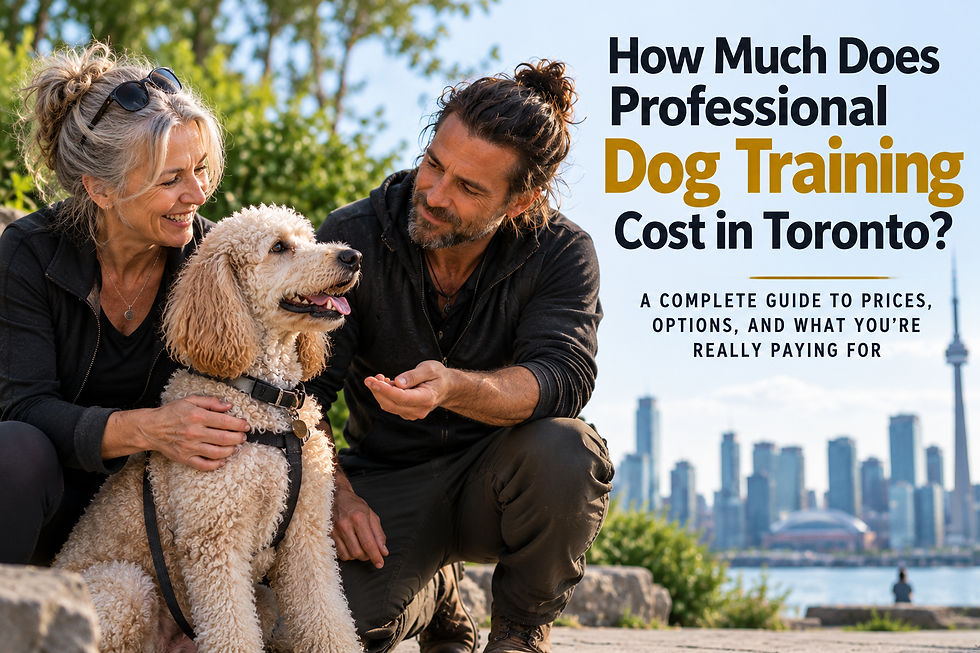
For a deeper look at pricing, read my guide: How Much Does Professional Dog Training Cost in Toronto?
What Makes My Approach Different?
I'm Jesse Sternberg, founder of Peaceful Alpha and author of Enlightened Dog Training.
Over the past 20 years, I've studied a wide range of dog training philosophies, including positive reinforcement, clicker training, balanced training, and behaviour rehabilitation.
I've also spent years managing groups of dogs and observing how they communicate with one another.
What fascinates me most isn't how quickly a dog can learn a command.
It's how much dogs communicate without words.
I've watched frightened dogs become more confident when their environment and interactions changed.
I've watched overstimulated dogs learn to settle when their owners became more consistent and predictable.
And I've watched relationships improve when people stopped focusing exclusively on obedience and began paying attention to communication.
My approach combines practical training techniques with a deeper understanding of canine body language, emotional states, and human behaviour.
Because dog training isn't just about what happens at the end of the leash. It's about what happens at both ends.
How Do You Know Which Training Program Your Dog Needs?
Ask yourself three questions.
1. Where does the problem happen?
If your dog struggles mainly at home or during neighbourhood walks, in-home training offers the opportunity to work directly in those environments.
2. How involved do you want to be?
If you want to develop your own handling skills and understand your dog's behaviour, private training provides direct coaching.
3. What does your dog need emotionally?
Some dogs benefit from structured practice in a different environment.
Others, especially those experiencing significant fear or stress, may benefit from learning gradually in familiar surroundings.
A qualified trainer should help you evaluate these factors before recommending a program.
Looking for Private In-Home Dog Training in Toronto?
If your dog is reactive, anxious, overly excited, pulling on the leash, or struggling with household boundaries, personalized training may help.
I'm Jesse Sternberg, author of Enlightened Dog Training and founder of Peaceful Alpha.
I offer private in-home dog training in Toronto, working directly with dogs and their families to improve communication, build confidence, and address challenging behaviours.
My complete program includes eight private sessions and one year of follow-up support.
You don't just get a trainer for your dog. You learn how to become a better guide for your dog.
Contact me to discuss your dog's challenges and find out whether private training is right for your family.
Frequently Asked Questions
Is in-home dog training better than board and train?
Neither is universally better. In-home training allows owners to learn alongside their dogs in familiar environments. Board and train provides concentrated training but requires a strong owner handover and continued practice at home.
Will my dog remember training after board and train?
Dogs can retain learned skills, but they may not automatically perform them in new environments or with different handlers. Owner education, practice, and follow-up support help transfer those skills.
Can private dog training help with aggression?
Yes, private training can help address many forms of aggressive behaviour by identifying triggers, improving safety, and developing appropriate responses. Serious cases may also require veterinary assessment or specialist support.
How many private training sessions does a dog need?
It depends on the dog's behaviour, learning history, environment, and owner goals. Some issues improve relatively quickly, while more complex challenges require ongoing practice.
Do I need to be present during in-home dog training?
Owner participation is strongly encouraged. Learning how to communicate with and guide your dog is an important part of maintaining progress.
Is board and train worth the money?
It can be worthwhile for certain dogs and families, especially when the program provides appropriate training, transparent methods, owner instruction, and ongoing support. The quality of the program matters more than the number of days your dog stays.

Comments